"What are gravitational waves?"
Here is a great primer from Brian Greene:


Here is a great primer from Brian Greene:
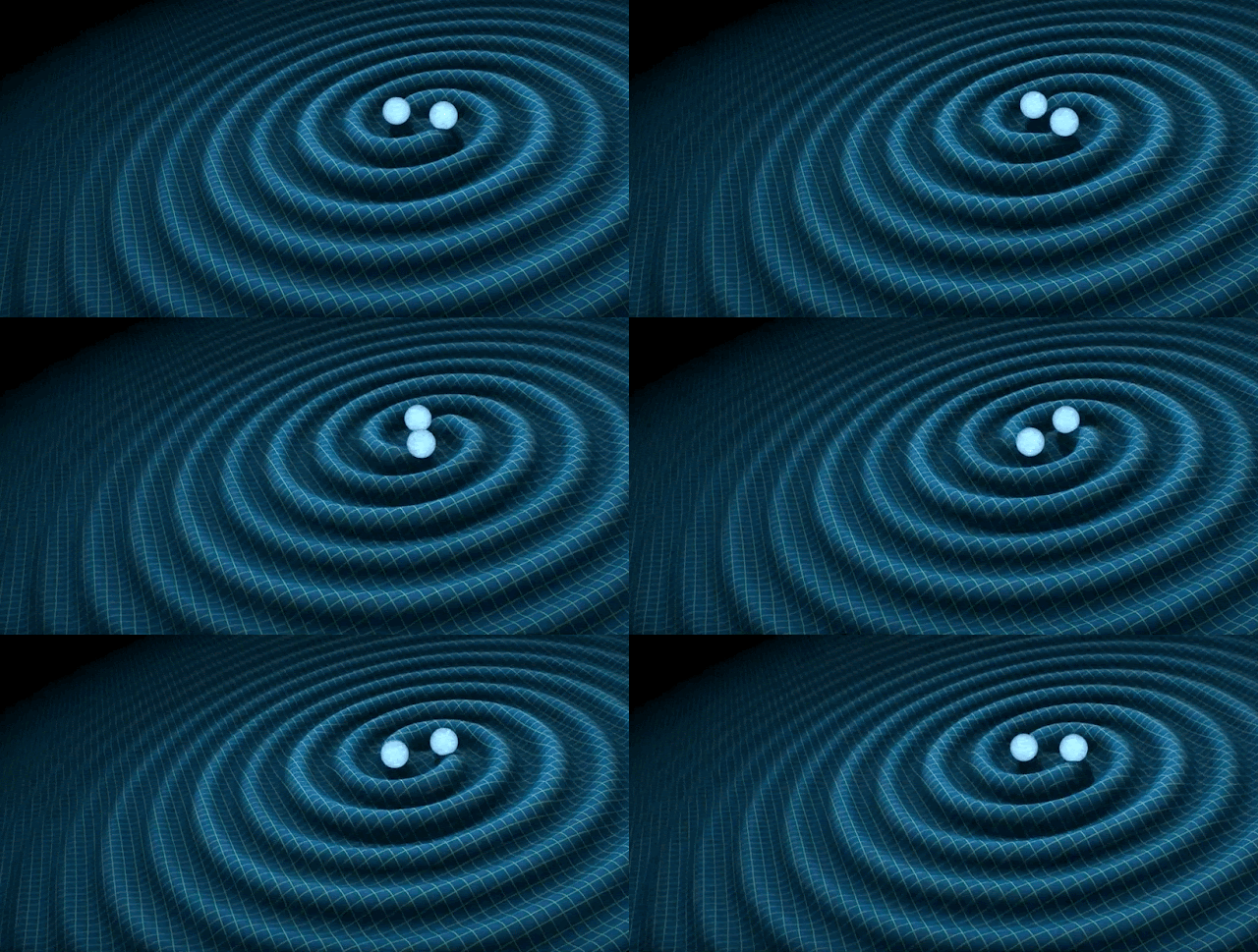
Gravitational waves can be thought of like waves in the surface of a lake. When there is some disturbance in the lake, say a poodle jumps into the water, waves propagate across the surface. The same goes for gravitational waves, but rather than propagating through water, they propagate through space and time.
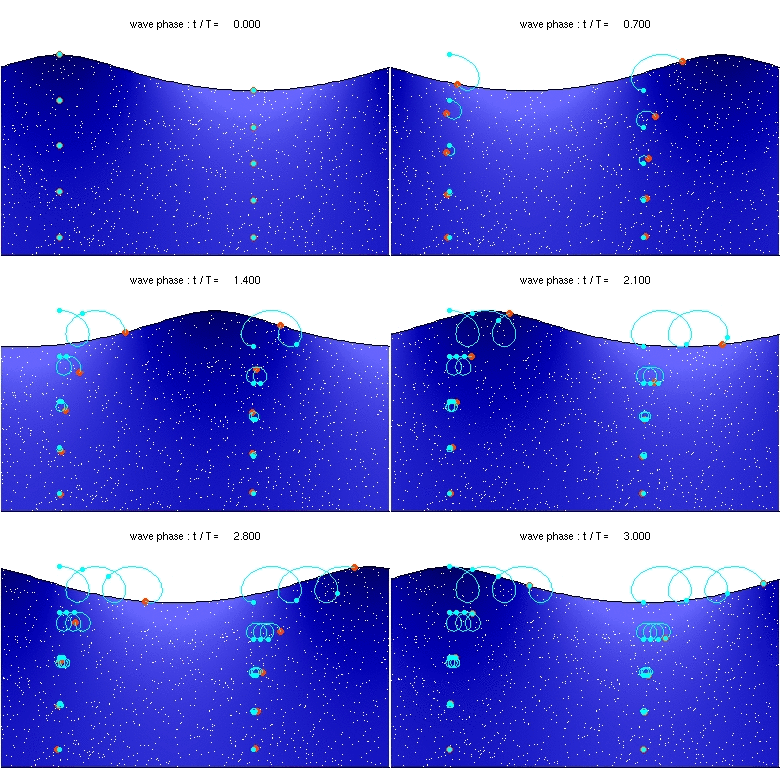
A bug on the surface of the water a little ways away from the poodle will travel in little circles, moving up and down in the wave (below [top]), while an object "caught up" in a gravitational wave actually gets stretched and compressed while staying still as space and time are altered around it. In the case of this circle (below [bottom]), you can see how it gets distorted and changes shape.
A bug on the surface of the water a little ways away from the poodle will travel in little circles, moving up and down in the wave (below [top]), while an object "caught up" in a gravitational wave actually gets stretched and compressed while staying still as space and time are altered around it. In the case of this circle (below [bottom]), you can see how it gets distorted and changes shape.

Note that the points in the circle get closer and further away as the circle flexes, this property is what we exploit in order to detect gravitational waves, but more on that a little later.
Going back to our poodle, the disturbance that a poodle jumping into a lake makes is pretty large relative to the water molecules. The opposite is true for gravitational waves, they are extremely small, though everything creates gravitational waves. Even by typing this sentence, my fingers are creating small gravitational waves, though they are immeasurably insignificant.
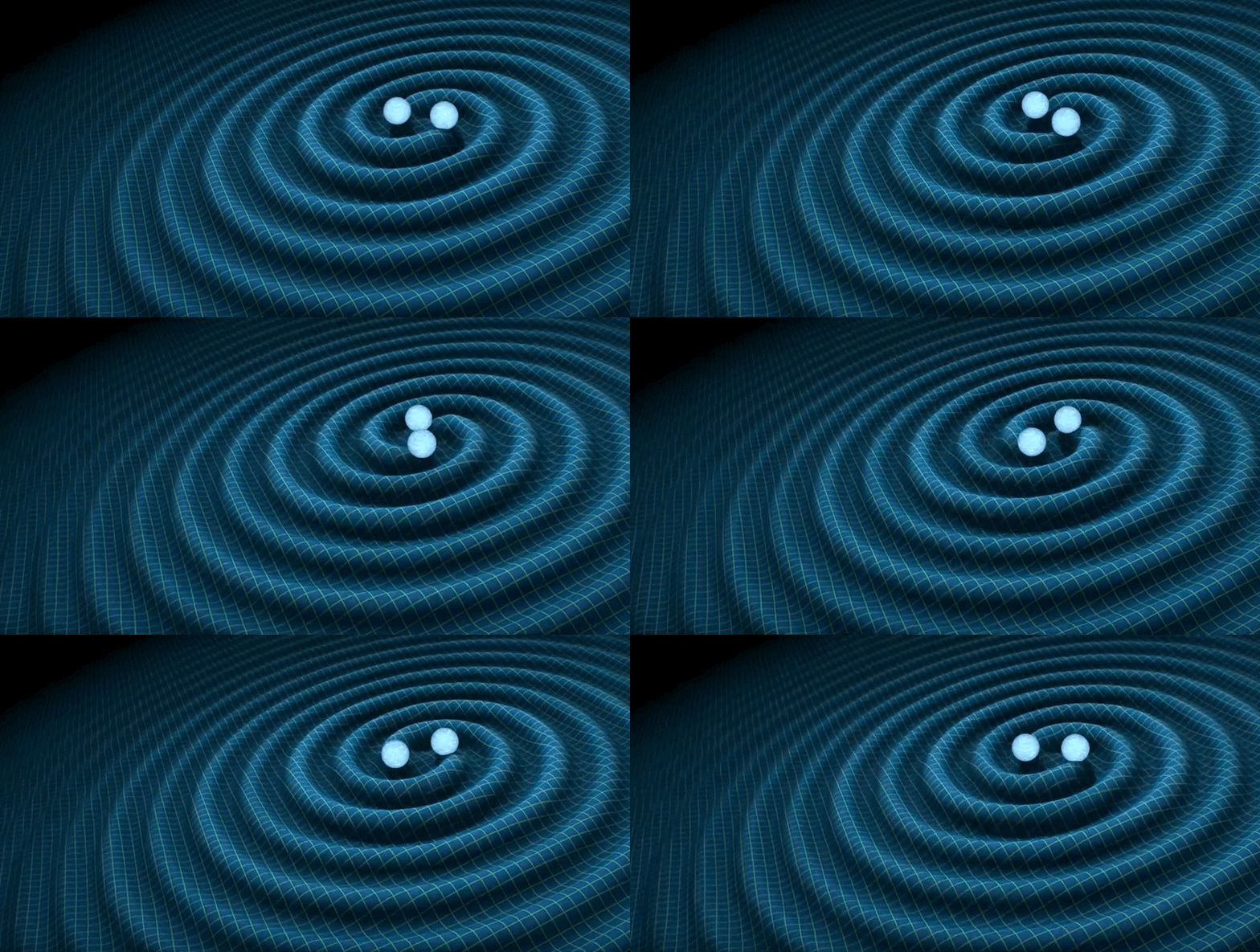
Gravitational waves produced by large, energetic events are they only types of waves we have a hope of detecting, because they will warp space enough for us to notice. Some common sources of large gravitational waves are supernovas, neutron stars, or black holes rotating around each other (above) and merging.
Gravitational waves produced by large, energetic events are they only types of waves we have a hope of detecting, because they will warp space enough for us to notice. Some common sources of large gravitational waves are supernovas, neutron stars, or black holes rotating around each other (above) and merging.
Let's move on to the specific gravitational wave the LIGO team detected in late 2015. A little before 3pm mountain time on September 14th of 2015, a gravitational wave swept over the earth, altogether lasting about a tenth of a second. The event that created this wave occurred about 1.3 billion years ago, when two black holes, each about 30 times the mass of our sun (one 36, one 29), began rapidly rotating around each other, then merged. Here are two short videos visualizing the event, one as if you were up close observing it with your own two eyes, and another showing the warping of the gravitational field around the event.
The distortion is caused by gravitational lensing, gravity strong enough to alter the direction of beams of light.
This merging of black holes created a cataclysm in the fabric of spacetime, and the rippling from this event has affected the Earth 1.3 billion years later by compressing it and stretching it by about a nuclear diameter. Here's a short video showing this effect, greatly exaggerated:
<sidenote>
Humans are not good at thinking about scale. Our brains have never needed to be able to comprehend a billion of anything, so evolution didn't set us up to be able to comprehend this sort of number. Thinking in analogies helps, so I came up with this: The same gravitational wave that stretched and compressed Earth by an atomic diameter stretched and compressed the entire solar system by the length of a single skin cell, and the Milky Way galaxy by the distance someone could run in about an hour.
</sidenote>
"How did we detect it?"
 |
| Aerial view of LIGO |
...by looking very closely at two specific beams of light. The two LIGO observatories in Washington and Louisiana do not look up at the sky, but rather have a very unique setup designed to detect differences in the space between a few sets of mirrors.


Cheers,
- Scott
P.S. - If you turn those waveforms above into audio, you get the sound of a gravitational wave, and it's fantastic:
Email subscription (one per post):
tinyletter.com/scottsieke

Here's how to observatory works:
In the above image, the leftmost element is a really expensive laser pointer.
- The laser pointer produces incredibly pure light of a specific wavelength (1064 nm).
- The laser beam hits a half-silvered mirror that splits the beam by letting half the light through and reflecting the other half.
- Each beam then travels 4km through a vacuum, bounces off a mirror, then travels 4km back to the half silvered mirror at the base.
- The beam is then recombined and received at a very sensitive detector (H-shaped object near bottom)
A quick not about interference (the "I" in "LIGO"): Light, being a wave, can either "stack up" or "cancel out." In the image below, you can see that where peaks line up with peaks, the beam multiplies and gets stronger (constructive), and where peaks line up with troughs, the beam cancels out (destructive).
As the mirrors move closer and further apart due to the warping of spacetime, the waves of light align and misalign, making the beam "turn on" and "turn off," as you can see in the animation above.
It's at this I must admit I lied to you. The beam of light pointing at the detector doesn't actually turn on and off, because the warping over a distance of 4km is merely 1/1000th the size of a proton. This is nowhere near enough to warp the mirrors enough to move from fully constructive to fully destructive interference. In actuality, the beam changes by an incredibly small fraction and the change in the brightness in the beam is exceedingly slight. As a result, the instruments that detect the light have to be very precise. While in operation, the LIGO team has had to take remarkable measures to create such a precise instrument. Among the factors that were caught up in the noise they recorded were: individual atoms of gas in the 4km long vacuum tubes, trucks driving on highways kilometers away, as well as quantum effects in the mirrors themselves. That's right, the fact that mirrors are made of atoms was something the team has to consider and remove from their data.
 |
| Here is the actual data. The two signals were received 7ms (speed of light delay) apart from each other, and matched predictions nearly perfectly. The confidence level was reported at 99.999994% |
One last thing I'll mention.
While reading the paper about the detection, I was struck by this table:

Take a look at the first three items. These are the masses of the two black holes, and the resulting black hole after the merger (M☉ is solar mass).
There are three solar masses missing.
Einstein figured out what's called mass-energy equivalence (E = mc2), which, at its simplest, states that a particular mass m, say an apple, can be converted into a particular amount of energy, E. Using this equation, we can figure out that our apple contains more than enough energy to form this crater:
 |
| Notice the parking lot near the bottom |
Using this same equation, three solar masses is the amount of energy released in 5000 supernovae, or to use a common analogy, roughly one million billion billion billion Hiroshima bombs. That's the amount of energy required to make a tiny blip on the screen of a ludicrously precise instrument on earth 1.3 billion light years away.
- Scott
P.S. - If you turn those waveforms above into audio, you get the sound of a gravitational wave, and it's fantastic:
Email subscription (one per post):
tinyletter.com/scottsieke


