Showing posts with label astronomy. Show all posts

Monday, February 27, 2017

Potpourri

Hello!

There are a lot of topic I run across that I can't write a whole worthwhile blog post about, but I'd still like to share these little tidbits with you, so I'll try to assemble a few of those here.


Tidbit 1:

There is a bright red star in the constellation Scorpio called "Antares." It is a fascinating star that is 883 times larger than our star by diameter, meaning that if it were in our solar system, it would envelop all four rocky planets.

The fact that it is so red, coupled with the fact that the star is usually visible for most of the year created confusion because astronomers would often mistake the star for Mars, which eventually led to its name:

ant... = not
...ares = Mars

We called the star "not Mars."


Tidbit 2:

I was curious what the name for those coffee cup wraps was, so I looked it up. On the Wikipedia page, I found a whopping 7 "aka's" in the Wikipedia page. One of them was the term "zarf." A zarf is an ornate metal device made to hold a coffee cup. Here is one from the British Museum:

Image: britishmuseum.org

I think I'm going to call those coffee sleeves "zarfs" from now on.

Tidbit 3:

I heard a story about the early space mission Aurora 7, launched with Scott Carpenter inside on May 24th, 1962. The mission went mostly to plan, except for one variable the folks on the ground couldn't control: Scott. Transfixed by the view from the window, Carpenter used attitude control to point the capsule at things he was interested in seeing, and as a result landed 250 miles off course - a fact NASA was not pleased about.

The astronauts got to name their own missions, and Scott Carpenter decided to call his "Aurora." Now, he grew up in Boulder at Aurora and 7th, so many Boulderites (including me) assumed it was a reference to his street corner until I saw the video below. It turns out it was because his orbit would enable him to see the aurora borealis for the first time.


Tidbit 4:

Image: 99percentinvisible.org - check them out if you haven't yet!

You have almost certainly seen these. Paths where people simple cut the corner and trample the grass to get where they are going. As many hours as someone might put into designing walkways in parks or campuses, many a time, people will take the way that best suits them. These paths actually have a name - desire paths. There's even a subreddit for it.


Fairly appropriate, I'd say

Tidbit 5:

Brothers and sisters together are called "siblings," but did you know that you can refer to your nieces and nephews together as your "niblings?" Also - your brother or sister can be called your 0th cousin.

More:


Tidbit 6:

Image: Wikimedia Commons


The tongue twister "She sells sea shells sitting by the seashore" refers to a real person - Mary Anning. Anning lived in England in the early 19th century and was a paleontologist, fossil collector and dealer. Among other accomplishments she was the first to discover complete plesiosaur and ichthyosaur fossils.

Tidbit 7:

If you happen to have a kidney stone the solution for passing it might be in an unexpected place: Frontierland at the Disney World Resort in Orlando. According to this study, kidney stones are passed 63.9% of the time after riding the Big Thunder Mountain Railroad.


Image: AmaryllisGardener


A flight to Orlando and a ticket to Disney World:

Cheaper than some healthcare.

I really suggest reading that paper through. It's full of little gems like this one:


Many people in the United States probably live within a few hours’ drive of an amusement park containing a roller coaster with features capable of dislodging calyceal renal calculi.

Here's a video of the researcher describing his work: 


I love science.

Cheers,

   - Scott


Email list (one per post):


Monday, August 29, 2016

The Science of Game of Thrones

The show Game of Thrones is not for everyone. It can be gruesome, crass, lewd, rude and otherwise skewed. That being said, I love it, as do many others. Like all fantasy stories it takes place in a fictional, created world. One of the few rules in a created world is that it needs to be internally consistent.

In this post I will compare the science and physics of George R.R. Martin's created world against our own real world. George R.R. Martin's world is internally consistent, and shares much in common with ours, but not everything (notably: dragons). Due to this difference, making a comparison between the two worlds is inherently pointless. The only purpose will be to learn some neat things about our own world along the way.

Two quick points: One, I've separated this post into two sections, non-spoilers and spoilers. The latter section will be denoted thusly:


<SPOILERS>

Second, you needn't be a Game of Thrones fan to read this, as I'll be briefly explaining each topic at hand, and the bulk of the post will be about real-world science and physics.


Variable Seasons

In the Game of Thrones universe, seasons are variable, and as far as I can tell only include summer and winter skipping fall and spring altogether. Seasons tend to last about 5-7 years each. The most recent summer, unusually long, has lasted about a decade when the show starts.

So what gives? How can seasons be variable? On Earth, some years are harsher than others, but we can be certain that we'll see one summer and one winter on each trip around the sun.

Perhaps on the planet on which Westeros (the island on which the series mostly takes place) lies, traces out an unstable orbit around its central star or stars. Scientists have discovered some very strange star systems that have 2, 3, or even up to five stars.


Image:www.ras.org.uk

If the Game of Thrones planet was in orbit around one of the stars in this five star system, we might get the very odd seasons we're looking for, but here's the rub - these stars are pretty far apart. Looking at the scale, we can see that you could easily nestle every one of our own planets in the middle of this system, meaning that the light from the distant stars probably wouldn't have much of an effect on the seasons. On the other hand, if our planet was in the triple-star part of this system, I imagine it would be a bit brighter during the nights than in depicted in the show.

Alright - what about a really elongated orbit? That would change seasons pretty dramatically. Unfortunately, this doesn't work either, as this system is still predictable, and you'd end up with extremely long winters and short, intense summers.


Image: www.uwgb.edu


Comets spend well over half their time in the most distant parts of their orbit.
Haley's Comet spends half its time past Neptune alone.

So that's not it either... Maybe the planet is haphazardly tumbling through space after being hit by several large objects heading in different directions in the planet's distant past. I like this idea; it accounts for a fair bit of unpredictability, and could be a perfectly good reason why the seasons are so askew. Here's the interesting bit though - This sort of orbit doesn't arise in the normal way, that is, a planet condensing and aggregating as part of a huge cloud of interstellar gas around a central star or stars. This planet would almost certainly be a so-called 'rogue planet,' a planet that was floating through empty space, eventually being captured by the central star and entering orbit. That would account for the lack of a somewhat stable orbit, and would mean by definition that our familiar cast of characters on Westreros are indeed aliens in their own solar system (as if we needed yet another show about aliens).

If variable seasons are of interest to you, you can read more HERE.

Valyrian Steel

Valyrian steel in Game of Thrones is an ancient product of metallurgy whose secret has been lost to the ages. Renowned for their sharpness and ability to hold an edge, Valyrian steel weapons have become rare, and as such, are either reserved for royalty or are treasured family heirlooms whose history can be traced back hundreds of years.

Here is a description of Widow's Wail, a sword from the books:
"MosValyrian steel was a grey so dark it looked almost black, as was true here as well. But blended into the folds was a red so deep as the grey. The two colors lapped over one another without ever touching, each ripple distinct, like waves of night and blood upon some steely shore."
And here is a picture of real-life Damascus Steel:

Image: Frank Schulenburg

Damascus steel is made by folding many layers of different types of steel (high carbon and low carbon, for instance) together over and over, then drawing the layers out into a blade. If you start with 7 sheets, and fold it over once, you have 14-layer steel, fold it again and you have 28-layer, and so on and so forth. Once the blade is formed, the blacksmith dips the steel into ferric chloride, and this distinctive ripple pattern emerges because ferric chloride etches different types of steel to different shades. This produces the lovely ripple pattern seen in Damascus and Valyrian steel weapons.

Interested in Damascus steel and how it's made? Check out this video:


Geology of Westeros

This is a pretty interesting topic, and I can't do it anymore justice than the wonderful people at the Generation Antropocene podcast. Click around their website HERE and enjoy. They've certainly done their research.


The Wall

A while ago (thousands of years) a massive wall of ice was built in the far north of Westeros. It is 300 miles long, 700 feet high, and perhaps 100 feet deep. This is a total volume of ~ 3.14 (huh, pi) kilometers cubed, or about 1.3 Mount Everests. All told, this Wall has on the order of 10^15 joules of gravitational energy locked up in it, about a thousand times more than the pyramid at Giza (~10^12 joules). This is roughly the same amount of energy required to launch 1,000 of the Apollo 11 Saturn V's, and the minimum amount of energy that would have been needed to construct the Wall. 

You can build stone up to quite a height, but ice, not so much. Among the tallest fully stone structures is the Washington Monument at 169 meters, and the tallest ice structure I could find was an ice palace made in China in 2013, at 48 meters.


The physics that govern whether or not the Wall from Game of Thrones would be possible are a bit beyond my grasp, but the short answer is that the Wall absolutely could not stand, and I can't tell you just how much it couldn't stand because I'm not an engineer, but let's agree that it's a lot.

Sidenote - I was using Wolfram|Alpha to do these calculations, and I was hoping to get one of these bad boys:


... but I didn't. If you're curious about the question in the text field above, check out the answer HERE.


<SPOILERS>

The Dothraki

We'll start the spoiler section off with one from Season 1. In Game of Thrones, there is a group called the Dothraki, which are very similar to the Mongols in the early 13th century, just before their unification under Temujin, better known as the great leader, or Genghis Khan. Both groups have a relationship with horses, are nomadic, and have specific rules against bloodshed, considering it dishonorable, among other similarities.

Be waned, this next part is gruesome, it's Mongol history, after all (feel free to skip ahead to the Wildfire section).

Being a big Mongol history geek, I was amazed in season one, when I saw the death of the character Viserys, executed by having molten gold poured on his head, I immediately thought of the once governor of Otrar, a man called Inalchuq.

Genghis Khan formed his empire from scratch by unifying many warring groups in the Mongolian steppes. In expanding the boundaries of his empire to new cities, the first step was usually to send a few ambassadors, along with goods for trade. This was exactly how he proceeded when reaching out to the city of Otrar.

Accounts differ, but due to either some small insult or greed, the governor Inalchuq seized the caravan and massacred every member, selling the goods and pocketing the dough (there may have been yeast, but dough here refers to cash).

News got back to the great Khan, and he responded by sending three more emissaries to demand punishment of the governor. The governor responded by beheading one emissary, unpleasantly dishonoring the other two, then sending them back to their Khan.

In retaliation, Genghis Khan personally led a months-long siege of Otrar, eventually breaching the walls and cornering the Governor, who was then summarily executed, reportedly by means of having molten silver poured onto his head. Sound familiar?


Wildfire

Wildfire, the green flame that is nigh impossible to extinguish, played a big role in the Battle of Blackwater, repelling Stannis' ships, but the destruction of the Sept of Baelor was where we saw the destructive power of wildfire on full display.

Wildfire acts a lot like a real-world substance called Greek Fire. Greek Fire has a long history, as it is an umbrella term describing many war-based applications of fire used by many historic cultures before and after the Greeks.


Image: Wikimedia


To simplify things, I'll discuss what I have come to consider as "standard Greek Fire." For the purposes of this post, "standard Greek Fire" is a highly flammable mixture of naphtha (pitch), saltpeter, sulfur, and calcium phosphate. A lot of the ingredients for self-oxidizing black powder are here, as well as pitch, a very sticky and flammable substance. This particular cocktail of ingredients would have been particularly devastating to a fleet of wooden ships approaching a foreign shore. Being self-oxidizing, Greek Fire could potentially burn underwater, and the pitch would have provided adequate stickiness to keep fire near wood for long enough to do some actual damage.

Greek Fire could have been deployed much the same way as depicted in the show: little clay pots and containers, set alight and hurled at the invading fleet.


Image: ancientresource.com


In digging around about Greek Fire, I found this quote from the Memoirs of the Lord of Joinville, describing the use of Greek Fire in the Seventh Crusade:
           "This was the fashion of the Greek fire: it came on as broad in front as a vinegar cask, and the tail of fire that trailed behind it was as big as a great spear; and it made such a noise as it came, that it sounded like the thunder of heaven. It looked like a dragon flying through the air. Such a bright light did it cast, that one could see all over the camp as though it were day, by reason of the great mass of fire, and the brilliance of the light that it shed."

That sounds a lot like Game of Thrones to me.


Dragons

This is a big topic, so I'll try to briefly touch on a lot of interesting points in this last section.

Dragon Fire

How do dragons go about making fire? We know they breathe it out of their mouths as seen time and time again, but how is it done biologically? Looking at game of thrones might give us our best clues, because we get some nice close-ups of the dragons' 'fire organs.'


Image: HBO


In the scene above the dragon is threatening to produce fire, but not actually breathing fire, giving us a good look at how this feat might be done. Notice that the fire originates in the far back of the throat, in the center. This goes against my initial theory that the dragon might mix two highly reactive chemicals, combining them outside of the mouth to avoid burns much like a flamethrower.


Image: HBO

I initially thought that these ducts on either side of the dragons jaw (above) would spew out those reactive chemicals, but now I'm thinking that these ducts may expel an accelerant, rather than the primary flame mechanism.

Alright, on to a reasonable model of how this might be done, and how the ability might have evolved. The digestive system produces a lot of flammable gasses, as seen in this clip from the show Mythbuters. Dragons, as obligate carnivores would have a short digestive system that produces a lot of natural gasses such as flammable methane. If the dragon evolved to store and pressurize this methane, while making it available to the front end rather than the back, this is the beginning of a functional flamethrower. As for production of a spark to set everything alight, two theories that dominate the discussion:


  1) Dragons eat small rocks to aid digestion like many birds do, and among these rocks might be particles of flint and steel, which may coat the teeth and produce small sparks when clicked together.
2) Dragons may use static ignition to ignite the fuel mixture, basically making use of static electricity to start a "pilot light."

Lastly, what about an evolutionary reason for fire breathing to come about? Dragons use their fire to intimidate, and as an offensive weapon, but I think the evolutionary driver may have been the ability to cook their food. Humans, once we learned how to utilize fire, immediately put it to use cooking our foods and meat. Eating cooked meat increases the caloric benefit, is safer and more efficient than eating raw meat. This, more than the offensive capabilities of fire breathing, would probably be the best evolutionary driver of the fire breathing ability.


A Quick Note on Dragons and Wyverns

People have argued at length about what constitutes a dragon, and what constitutes a Wyvern. A Wyvern, for those who have not heard the term, is a weaker and less powerful 'cousin' of the dragon, and has two feet and two wings. A dragon traditionally has four legs, as well as two wings on its back.

If we go strictly by the number of legs, many traditional dragons are in fact Wyverns, including those appearing in Game of Thrones.


Image: HBO
Poser

It's my personal view as a descriptivist,  as long as your meaning is clear, call it what you want. I wouldn't say that creature above is a weaker relative of a dragon... at least, not to its face.


Can Dragons Fly?

Some scientists used to be convinced that bumblebees couldn't fly, according to their understanding of physics. It turns out that bees can fly [citation needed] but we only figured it out after filming them in slow motion.

People have since asked that same question about dragons. Dragons obviously come in many shapes and sizes, but overall, small dragons probably could fly, while larger ones could not.

The main factors to consider are the square-cube law, and the body-weight-to-wing-size ratio. The square-cube law is the idea that the larger something is, the more volume it has in proportion to its surface area. Compare a human to an elephant; the elephant may be 2 or 3 times longer than the human is tall, but an elephant weighs many many times more. This is because as you increase something in one dimension, say length, the other two dimensions must increase as well (height and width). A human twice as tall as another won't weigh twice as much, but rather 23, or 8 times as much.


Image: N.R. Eccles-Smith
Steven

Let's consider a 5 meter, 1000 kg dragon named Steven, and a dragon that is twice as long named Carol. Sizable Steven has a 5 meter wingspan, and his wings are 2 meters wide, giving his wings a rough surface area of 10 square meters, and a body weight of 1000 kgs. His body-weight-to-wing-size ratio would be 100:1 (every square meter of wing must lift 100 kg).


Image N.R. Eccles-Smith
Carol

Colossal Carol, on the other hand would be twice as large, with a 10 meter wingspan and 4-meter-wide wings, giving her 40 square meters of wing real estate (a squared factor for two dimensions). Her weight, however increases as a cubed factor, so Carol would be an 8,000 kg dragon, and have a body-weight-to-wing-size ratio of 200:1.

For comparison, an eagle can weight about 5 kg, and has a wing surface area of a little less than a meter squared, so their ratio is roughly 5:1.

My best estimate for the largest dragon that could fly might be about car-sized, if it used most of its body weight for flight muscles and ate fairly constantly, which is essentially the formula for a giant hummingbird.


How Big do Dragons Get?

According to legend, the dragons in the Game of Thrones universe never stop growing, but just get larger and larger. The idea is that the only way to kill a dragon is via combat. Some have been documented as living for centuries.

This reminded me of a somewhat humbler animal here at home: the lobster.

Before I get too in-depth in nerding out about lobsters, I need to talk about two quick things, senescence and telomeres (a word that spell check insists is a misspelling of "omelette").

Senescence is the usual process of aging and includes things like the general weakening of the body, greater vulnerability to disease, exiting sexual maturity, and making terrible jokes.

Telomeres are the 'caps' of chromosomes - long repeating sequences of DNA base pairs that exist at the ends of chromosomes. Every time a cell divides, the chromosome becomes just a little bit shorter, and the telomeres are there so that this shortening of the chromosome destroys the useless genetic sequences, rather than any genes we would prefer to keep around.


Image: med.stanford.edu
Telomeres in green


So what does this have to do with lobsters? Lobsters do not undergo senescence in the same way most animals do. They are able to grow, mate, and go about their daily life right up until their death, just like dragons. Rather than slowly getting old and breaking down, they generally die by being eaten, molting their shell (a strenuous activity) or by getting a lethal disease. Some even make the claim that lobsters are immortal, even though this is not the case. They can, however, get impressively big.


Image: National Geographic

Part of the reason lobsters can get so large and live so long is that they have an particularly effective enzyme called telomerase that repairs damage to telomeres after cell division. Humans have this enzyme too, it just doesn't work as well (Interesting note, the 'useless' sequence that gets added to the ends of our chromosomes is "GGGTTA" over and over again).

Some of the interesting work in the field of gerontology (the study of ageing), looks at the Hayflick Limit, the number of times the telomeres can undergo cell division without losing functionality. The Hayflick Limit is much higher in lobsters than in humans.

Back to the main point - In the Game of Thrones universe, dragons can live for centuries, and they never stop growing. This is probably because a dragon has either impressively long telomeres, resulting in a high Hayflick Limit and long life lacking senescence, or they have fantastic telomerase, achieving the same end result.


</SPOILERS>


If you stuck around and read all that without having seen the show, thanks, and I hope you were able to learn a few things along the way, and if you are a show-watcher, enjoy this little extra nugget of Game of Thrones goodness in the off season as we wait for Season 7.


Cheers,

     - Scott


I don't publish these regularly, so the best way to know when a new one is up is through email subscription (one email per post, never more):

tinyletter.com/scottsieke

Monday, March 7, 2016

What Are Gravitational Waves?

About a month ago, two specialized observatories called LIGO announced the first direct detection of what are called gravitational waves. This discovery represents another step in knowing that science is on the right track with this whole "relativity" thing Einstein figured out a century ago. I'll answer the two most common questions I've gotten from my friends when they've been kind enough to let me talk about gravitational waves for entirely too long.


"What are gravitational waves?"

Here is a great primer from Brian Greene:


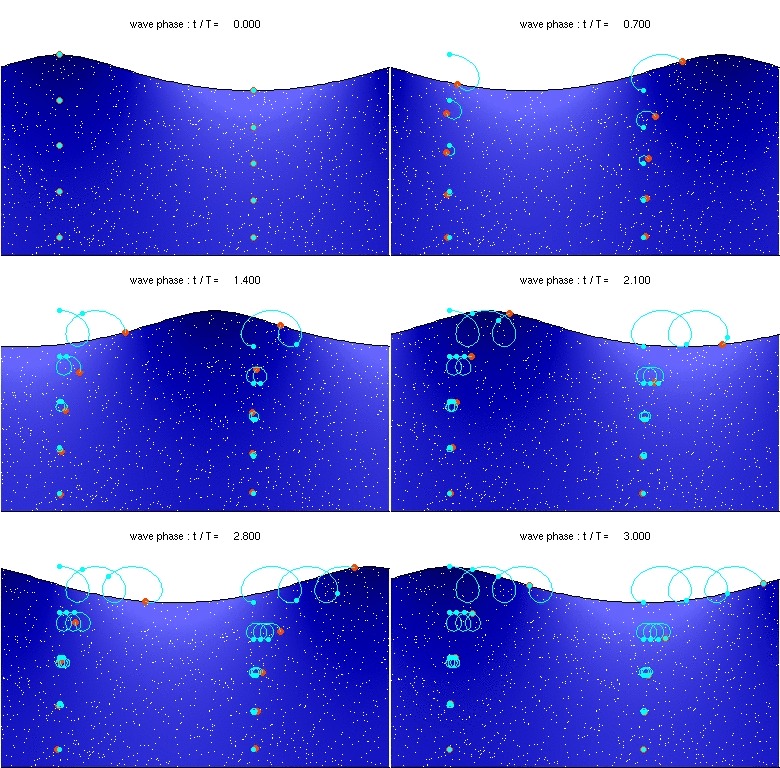
Gravitational waves can be thought of like waves in the surface of a lake. When there is some disturbance in the lake, say a poodle jumps into the water, waves propagate across the surface. The same goes for gravitational waves, but rather than propagating through water, they propagate through space and time.

A bug on the surface of the water a little ways away from the poodle will travel in little circles, moving up and down in the wave (below [top]), while an object "caught up" in a gravitational wave actually gets stretched and compressed while staying still as space and time are altered around it. In the case of this circle (below [bottom]), you can see how it gets distorted and changes shape.


Note that the points in the circle get closer and further away as the circle flexes, this property is what we exploit in order to detect gravitational waves, but more on that a little later.


Going back to our poodle, the disturbance that a poodle jumping into a lake makes is pretty large relative to the water molecules. The opposite is true for gravitational waves, they are extremely small, though everything creates gravitational waves. Even by typing this sentence, my fingers are creating small gravitational waves, though they are immeasurably insignificant.

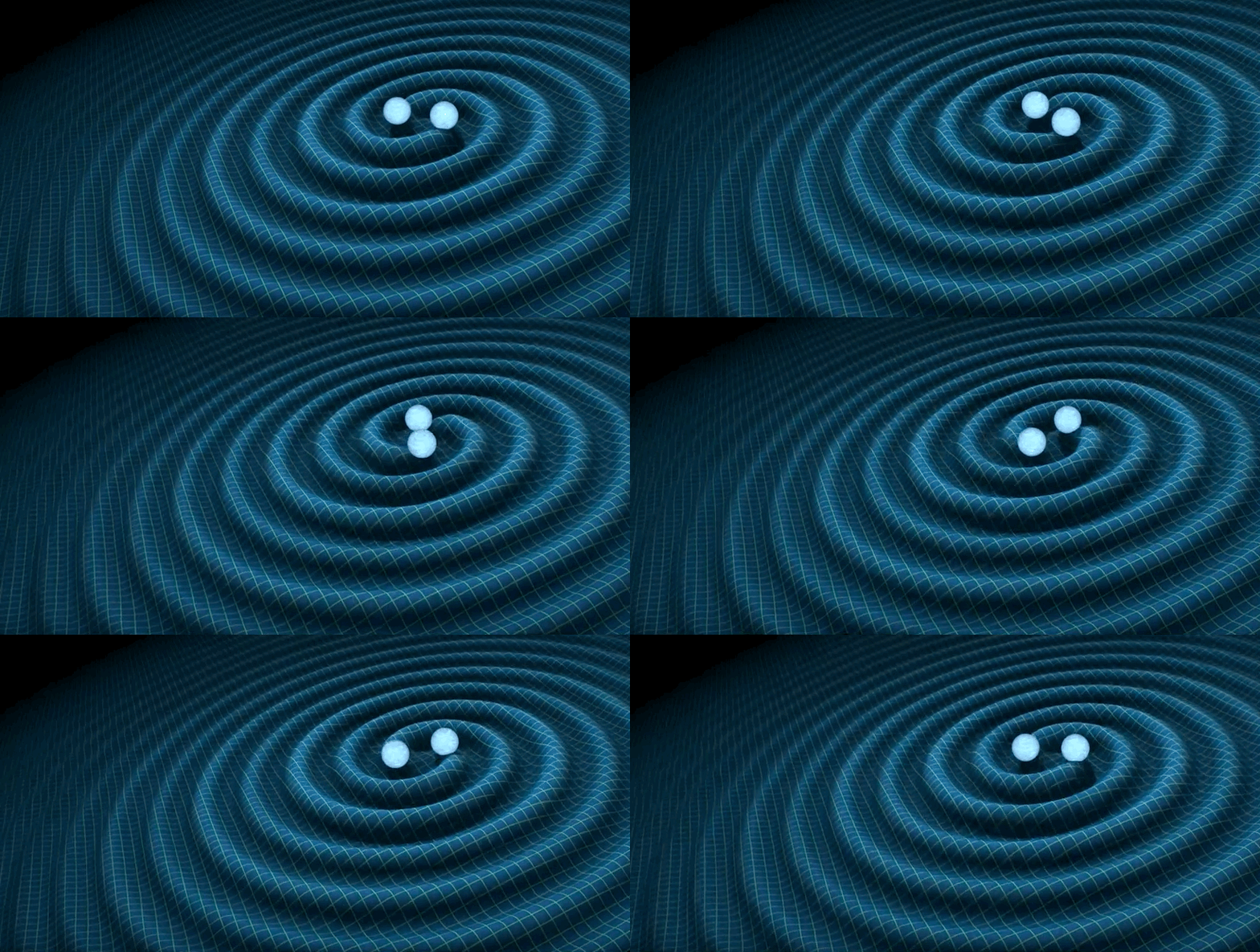
Gravitational waves produced by large, energetic events are they only types of waves we have a hope of detecting, because they will warp space enough for us to notice. Some common sources of large gravitational waves are supernovas, neutron stars, or black holes rotating around each other (above) and merging.

Let's move on to the specific gravitational wave the LIGO team detected in late 2015. A little before 3pm mountain time on September 14th of 2015, a gravitational wave swept over the earth, altogether lasting about a tenth of a second. The event that created this wave occurred about 1.3 billion years ago, when two black holes, each about 30 times the mass of our sun (one 36, one 29), began rapidly rotating around each other, then merged. Here are two short videos visualizing the event, one as if you were up close observing it with your own two eyes, and another showing the warping of the gravitational field around the event.


The distortion is caused by gravitational lensing, gravity strong enough to alter the direction of beams of light.


This merging of black holes created a cataclysm in the fabric of spacetime, and the rippling from this event has affected the Earth 1.3 billion years later by compressing it and stretching it by about a nuclear diameter. Here's a short video showing this effect, greatly exaggerated:


<sidenote>
Humans are not good at thinking about scale. Our brains have never needed to be able to comprehend a billion of anything, so evolution didn't set us up to be able to comprehend this sort of number. Thinking in analogies helps, so I came up with this: The same gravitational wave that stretched and compressed Earth by an atomic diameter stretched and compressed the entire solar system by the length of a single skin cell, and the Milky Way galaxy by the distance someone could run in about an hour.
</sidenote>


"How did we detect it?"


Aerial view of LIGO


...by looking very closely at two specific beams of light. The two LIGO observatories in Washington and Louisiana do not look up at the sky, but rather have a very unique setup designed to detect differences in the space between a few sets of mirrors.


Here's how to observatory works:

In the above image, the leftmost element is a really expensive laser pointer.
 - The laser pointer produces incredibly pure light of a specific wavelength (1064 nm).
 - The laser beam hits a half-silvered mirror that splits the beam by letting half the light through and reflecting the other half.
 - Each beam then travels 4km through a vacuum, bounces off a mirror, then travels  4km back to the half silvered mirror at the base.
 - The beam is then recombined and received at a very sensitive detector (H-shaped object near bottom)

A quick not about interference (the "I" in "LIGO"): Light, being a wave, can either "stack up"  or "cancel out." In the image below, you can see that where peaks line up with peaks, the beam multiplies and gets stronger (constructive), and where peaks line up with troughs, the beam cancels out (destructive).


As the mirrors move closer and further apart due to the warping of spacetime, the waves of light align and misalign, making the beam "turn on" and "turn off," as you can see in the animation above.

It's at this I must admit I lied to you. The beam of light pointing at the detector doesn't actually turn on and off, because the warping over a distance of 4km is merely 1/1000th the size of a proton. This is nowhere near enough to warp the mirrors enough to move from fully constructive to fully destructive interference. In actuality, the beam changes by an incredibly small fraction and the change in the brightness in the beam is exceedingly slight. As a result, the instruments that detect the light have to be very precise. While in operation, the LIGO team has had to take remarkable measures to create such a precise instrument. Among the factors that were caught up in the noise they recorded were: individual atoms of gas in the 4km long vacuum tubes, trucks driving on highways kilometers away, as well as quantum effects in the mirrors themselves. That's right, the fact that mirrors are made of atoms was something the team has to consider and remove from their data.

Here is the actual data. The two signals were received 7ms (speed of light delay) apart from each other, and matched predictions nearly perfectly. The confidence level was reported at 99.999994%


One last thing I'll mention.

While reading the paper about the detection, I was struck by this table:


Take a look at the first three items. These are the masses of the two black holes, and the resulting black hole after the merger (M is solar mass).

There are three solar masses missing.

Einstein figured out what's called mass-energy equivalence (E = mc2), which, at its simplest, states that a particular mass m, say an apple, can be converted into a particular amount of energy, E. Using this equation, we can figure out that our apple contains more than enough energy to form this crater:

Notice the parking lot near the bottom

Using this same equation, three solar masses is the amount of energy released in 5000 supernovae, or to use a common analogy, roughly one million billion billion billion Hiroshima bombs. That's the amount of energy required to make a tiny blip on the screen of a ludicrously precise instrument on earth 1.3 billion light years away.


Cheers,

   - Scott


P.S. - If you turn those waveforms above into audio, you get the sound of a gravitational wave, and it's fantastic:


Email subscription (one per post):


tinyletter.com/scottsieke